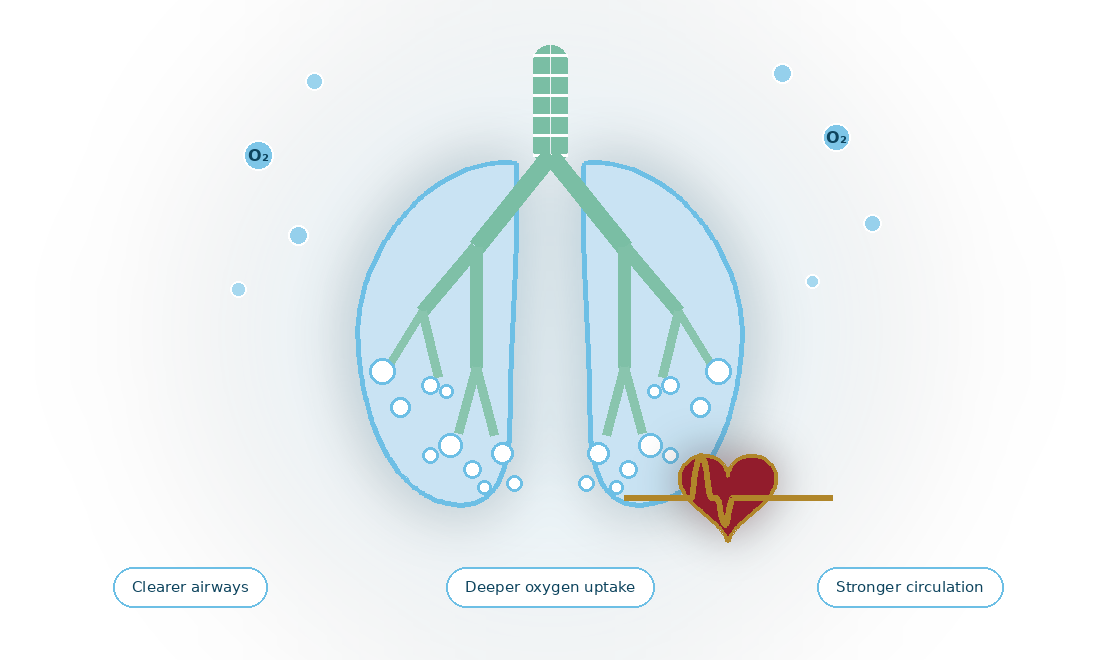
BreathEaseX Spray Format Review: Does Delivery Actually Matter?
Everyone asks whether the spray is a gimmick. There is a real argument for it and a real limitation too.
Anita S.
Why is BreathEaseX a spray instead of a capsule?
The spray format allows direct contact with throat and upper airway tissue, which matters for ingredients like manuka honey whose studied properties are contact-dependent. Oral mucosal absorption also bypasses first-pass liver metabolism. The trade-off is that a 30 ml spray cannot carry the gram-scale quantities that capsules can, which is why CardioEaseX is a capsule.
The practical experience
Four sprays into the mouth, once daily. It takes about five seconds and needs no water, which makes it genuinely more portable than a capsule.
The taste is mild and slightly sweet, dominated by the manuka honey with a faint herbal note underneath. It is not unpleasant and it does not linger. Nothing about the taste has ever made me reluctant to take it, which is not true of every liquid supplement I have used.
The bottle is 1 fl oz and lasts almost exactly thirty days at four sprays daily. The pump has worked reliably; there is a small amount left when it stops drawing properly, maybe a day or two worth, which is normal for a spray mechanism.
The mechanistic argument, assessed
I was sceptical that format was anything other than differentiation. Reading the reasoning changed my view partially.
The strongest case is manuka honey. Its studied properties concern direct interaction with mucosal tissue, and a capsule dissolving in the stomach never touches the throat. If manuka is in the formula for contact reasons, a capsule genuinely removes the mechanism. That is not marketing.
The secondary case is first-pass metabolism. Compounds absorbed across oral mucosa enter circulation without passing through the liver first, which changes how much survives. For compounds substantially degraded on first pass, this is a real difference.
So the format has a defensible rationale rather than being arbitrary.
Both formats, each doing what it does best
Spray for contact-dependent actives, capsules for the gram-scale cardiovascular ingredients.
The limitation nobody advertises
A 30 ml spray delivering four sprays daily is delivering a small total volume. There is a hard ceiling on how much active compound can be in it.
This is why CardioEaseX is a capsule. CoQ10, L-carnitine and magnesium are needed at high-milligram to gram quantities, and no spray delivers that.
It also means the BreathEaseX side is delivering smaller quantities of its actives than a capsule version could. Whether the delivery advantage outweighs the quantity disadvantage is a genuine question, and I have not seen it addressed directly anywhere. The honest position is that it is a trade-off rather than a free win.
Compared to capsules I have used
Convenience: spray wins clearly. No water, faster, more portable.
Adherence: mixed. It is easier to take but harder to remember, because it does not attach to a meal the way capsules do. I forgot the spray considerably more often than the capsules.
Perceived effect: the immediate throat sensation from the spray creates a stronger impression of something happening. I am wary of that, because a sensation is not evidence and I suspect it does psychological work that is not mechanistic.
Cost per active milligram: almost certainly worse for the spray. Liquids cost more to produce, ship and stabilise.
Storage and handling notes
- Keep it out of direct sunlight — manuka, NAC and vitamin D3 all degrade with light and heat.
- Do not leave it in a car in summer.
- The pump can be primed with a couple of test sprays when new.
- Aim toward the inside of the cheek rather than the back of the throat, which avoids the gag reflex.
- It travels well and is under the liquid limit for hand luggage.
Pros and cons
What worked
- Genuine mechanistic argument for contact-dependent ingredients
- Bypasses first-pass hepatic metabolism
- Fast, portable, no water required
- Mild pleasant taste that does not discourage use
What did not
- Hard ceiling on total active quantity in 30 ml
- Easier to forget than capsules taken with meals
- Likely higher cost per active milligram than capsule delivery
- The immediate throat sensation may create a misleading impression of effect
The verdict
The spray format has a genuine mechanistic rationale rather than being a gimmick, particularly for manuka honey where contact is the point. It is more convenient and slightly harder to remember. The unacknowledged trade-off is that a 30 ml spray has a hard ceiling on active quantity, which is a real limitation the marketing does not address. Worth understanding rather than accepting at either extreme.