Posture and Breathing: How Sitting Shrinks Your Lung Volume
Your lungs can only expand as far as the container around them allows. That container is more collapsible than you think.
Does posture affect breathing?
Yes, measurably. Slouched or forward-head posture reduces thoracic expansion and restricts diaphragm descent, lowering measurable lung volumes including vital capacity and forced expiratory volume. Studies comparing upright and slumped sitting show reductions in measured respiratory function. Thoracic mobility work, rib expansion drills and workstation adjustment all address it.
The container problem
Lungs have no muscle of their own. They inflate because the container around them — the thoracic cavity — expands, creating negative pressure that draws air in.
That expansion happens two ways: the diaphragm descends downward, and the ribcage expands outward and upward. Anything mechanically limiting either limits how much air can enter, regardless of how healthy the lung tissue is.
This is why posture is a respiratory variable rather than merely a musculoskeletal one.
What slumping does mechanically
Compresses the abdomen. Forward flexion reduces the space the abdominal contents can move into when the diaphragm descends. The diaphragm meets resistance earlier and travels less.
Restricts rib movement. A flexed thoracic spine holds the ribs in a partially depressed position, reducing their available range for expansion.
Alters muscle length relationships. Forward head and rounded shoulder posture places accessory breathing muscles in shortened positions and the diaphragm at a mechanical disadvantage, encouraging upper-chest breathing as compensation.
Reduces diaphragm dome height. The diaphragm generates force most effectively from a domed resting position; postural change flattens it, reducing its excursion.
The measurable effect
Studies comparing upright and slumped sitting positions have found measurable differences in respiratory function tests, including vital capacity and forced expiratory volume, within the same individual.
The effect is immediate. Sit up and the numbers improve within the same testing session. This is unusual and useful — most respiratory interventions take weeks, and this one takes seconds.
The longer-term problem is that sustained posture produces adaptive tissue change — shortened muscles, stiffened thoracic segments, altered motor patterns — and that takes considerably longer to reverse than it took to acquire.
Mechanics and airway support together
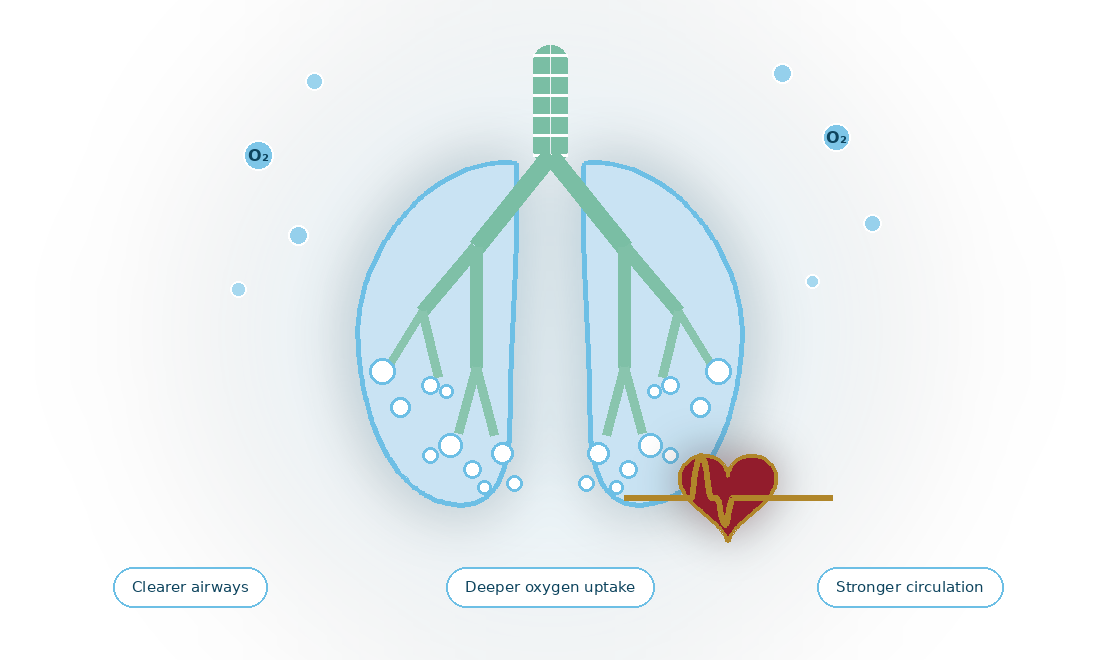
Better thoracic mobility widens the container. BreathEaseX addresses what is inside it.
What actually helps
Thoracic extension mobility. The thoracic spine stiffens with sustained flexion, and restoring extension range is the highest-value intervention. Foam roller extensions over the mid-back, seated extensions over a chair back, and thoracic rotations all address it.
Rib expansion work. Breathing into specific regions deliberately — hands on lower ribs, breathing to push the hands outward laterally — restores intercostal mobility.
Position changes rather than perfect posture. The evidence increasingly favours varying position over holding one ideal position. The best posture is the next one.
Workstation setup. Screen at eye height, feet supported, chair supporting the lumbar spine so the thoracic spine does not have to compensate.
Strengthening posterior chain. Rows, face pulls and thoracic extension strength work make upright posture sustainable rather than effortful.
The breathless-posture exception
Worth noting because it seems to contradict the above.
When someone is acutely breathless, a forward lean with forearms supported on thighs or a table genuinely helps. It stabilises the shoulder girdle so accessory muscles can assist ventilation without also having to stabilise, and it lets the diaphragm work more favourably in that specific configuration.
This is a rescue position for acute breathlessness, not a recommendation for how to sit all day. Both things are true.
A simple test
Sit slumped as you normally might at a desk. Take the deepest breath you can and note how it feels and how far it goes.
Now sit tall, ribs stacked over pelvis, and repeat. Most people notice a substantial difference immediately.
That difference is available to you thousands of times a day for free.