Air Pollution and Your Lungs: What You Can Actually Control
Outdoor air is a policy problem. Indoor air is largely yours, and it is often worse.
How does air pollution affect the lungs?
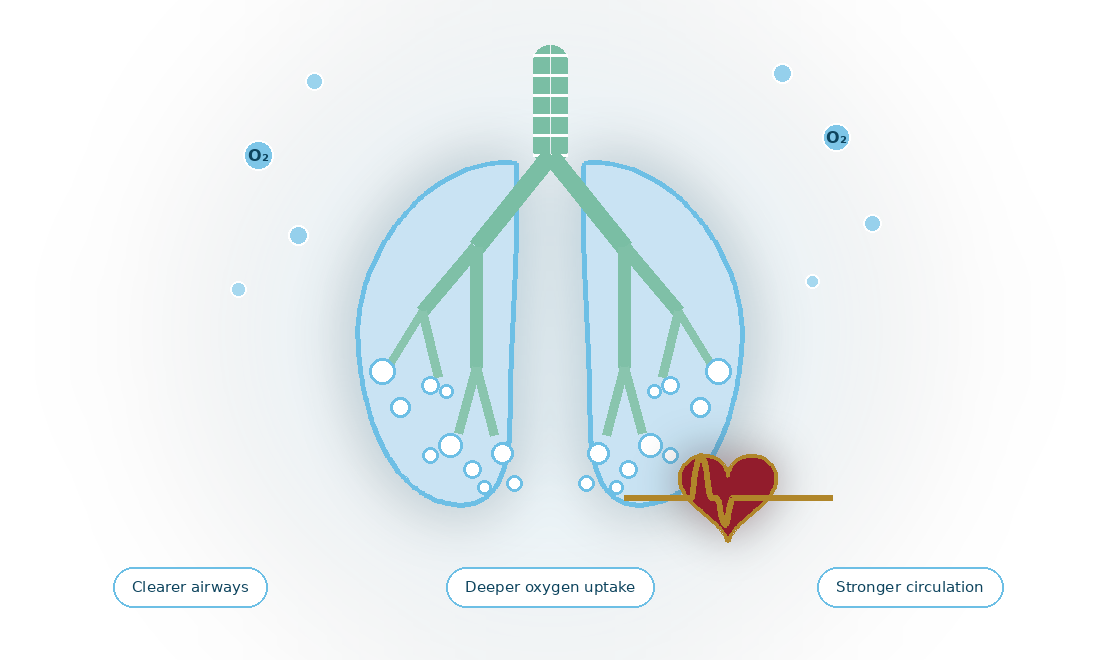
Fine particulate matter (PM2.5) is small enough to penetrate deep into the airways and reach the alveoli, where it provokes inflammation, oxidative stress and impaired mucociliary clearance. Long-term exposure is associated with reduced lung function, increased respiratory symptoms and higher rates of chronic respiratory disease. Indoor air quality — cooking ventilation, filtration and avoiding indoor combustion — is where individuals have the most control.
Why particle size determines the damage
Air pollution is not one thing, and the size of what you inhale determines where it lands.
Larger particles — above roughly 10 micrometres — are mostly filtered by the nose and upper airway. PM10 reaches the larger bronchi. PM2.5, at 2.5 micrometres and below, penetrates deep into the small airways and reaches the alveoli themselves, where gas exchange happens and where clearance mechanisms are weakest.
Ultrafine particles below 0.1 micrometres can cross into the bloodstream, which is why air pollution has cardiovascular as well as respiratory associations.
What it does once there
Deposited particles provoke inflammatory response, generate oxidative stress, and impair mucociliary clearance — reducing the mechanism that would otherwise remove them.
Chronic exposure is associated with reduced lung function measures, increased respiratory symptoms, higher rates of chronic respiratory disease and worsened outcomes in existing conditions. The World Health Organization treats it as a major environmental health risk, and the overwhelming majority of the global population lives in areas exceeding recommended limits.
Support your airways against cumulative exposure
BreathEaseX combines mucolytic and antioxidant support for airways carrying decades of accumulated particulate load.
The indoor point most people miss
Indoor air is frequently more polluted than outdoor air, and it is where most people spend the large majority of their time. It is also where you have actual control.
Gas cooking is the single largest fixable indoor source in many homes, producing both fine particulates and nitrogen dioxide. Extraction fans exist and are widely unused. Using one changes measured indoor levels substantially.
Indoor combustion of any kind — candles, incense, wood burners, open fires — is a significant particulate source. Scented candles are not a health product.
Dust and dander accumulate in soft furnishings and are resuspended by movement.
Cleaning products and air fresheners contribute volatile organic compounds, and air fresheners in particular add to the problem while masking it.
What actually helps
- Use the extraction fan every time you cook. Lowest cost, highest return.
- HEPA filtration in the bedroom. You spend a third of your life in one room; filtering it is efficient.
- Ventilate deliberately. Open windows when outdoor air quality is good, which is often early morning away from traffic peaks.
- Stop indoor combustion. Including candles.
- Choose quieter routes. Walking one street back from a main road measurably reduces exposure. Pollutant concentration falls steeply with distance from traffic.
- Check air quality indices and reduce outdoor exertion on high-pollution days — exercise increases the volume of air you inhale several-fold.
- Doormats and shoes off. A meaningful fraction of indoor particulate is tracked in.
What does not help
Ozone generators and ionisers. Ozone is itself a respiratory irritant. Avoid these.
Air fresheners. Add VOCs while masking odour.
Most houseplants, as air purifiers. The often-cited NASA research was conducted in sealed chambers and does not translate to real rooms at realistic plant densities. Keep plants because you like them.
Surgical masks, for particulate protection. They do not filter PM2.5 effectively. Properly fitted N95 or FFP2 respirators do.