Pollen and Your Airways: Beyond Sneezing
Hay fever is usually described as a nose problem. The lower airway is involved more often than people realise.
Can pollen allergies affect your breathing?
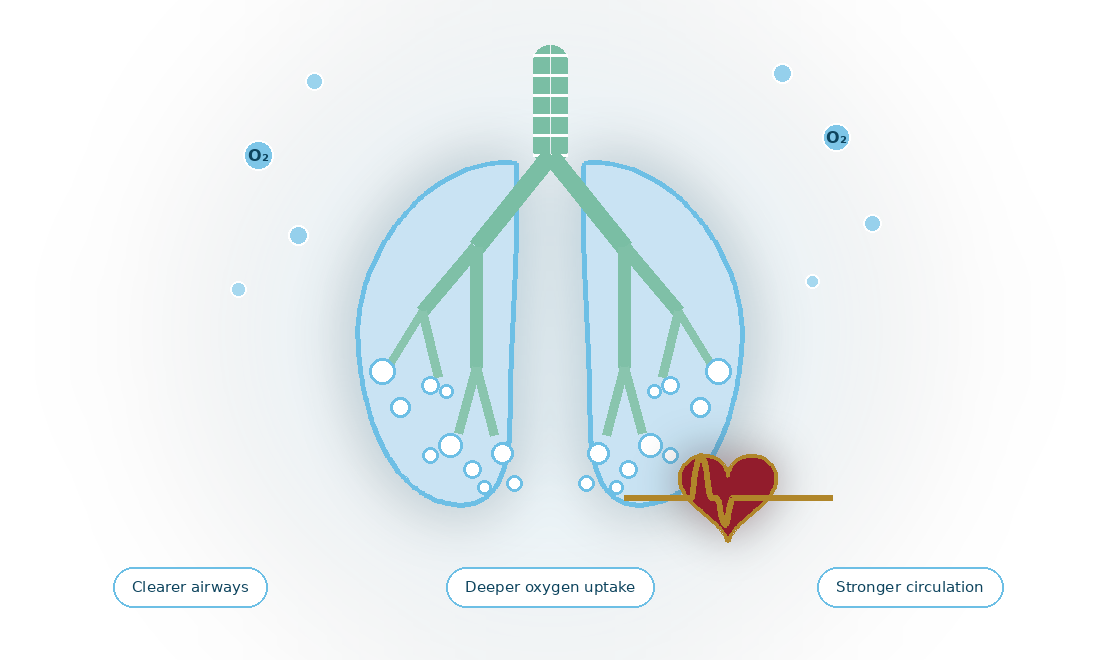
Yes. Allergic rhinitis and lower airway inflammation are closely linked — the united airway concept holds that the upper and lower respiratory tracts function as one interconnected system. A substantial proportion of people with allergic rhinitis have measurable lower airway inflammation, and untreated rhinitis is associated with worse asthma control. Nasal obstruction also forces mouth breathing, which bypasses air conditioning and filtration.
The united airway
Clinical practice historically treated the nose and the lungs as separate territories. The evidence has moved decisively away from that.
The upper and lower respiratory tracts share continuous epithelium, comparable immune cell populations and interconnected neural reflexes. Inflammation in one is frequently accompanied by inflammation in the other.
A substantial proportion of people with allergic rhinitis have measurable lower airway inflammation even without an asthma diagnosis, and untreated rhinitis is associated with poorer asthma control in those who do have it. Treating the nose improves lower airway outcomes.
The nasal obstruction problem
Beyond the shared inflammation, blocked nasal passages force mouth breathing, and this has direct mechanical consequences.
The nose filters particulates, warms air toward body temperature and humidifies it substantially. Mouth breathing bypasses all three functions, delivering cooler, drier, less filtered air directly to the lower airway.
So a blocked nose during pollen season means the lower airway receives both more allergen and worse-conditioned air, at exactly the time it is already inflamed.
Support the lower airway through allergy season
BreathEaseX includes quercetin, studied for mast cell stabilisation, alongside NAC and olive leaf polyphenols.
Knowing your season
| Source | Typical peak (Northern Hemisphere) | Notes |
|---|---|---|
| Tree pollen | Late winter to late spring | Birch, oak, ash, plane; often the earliest trigger |
| Grass pollen | Late spring to mid summer | The most common trigger overall |
| Weed pollen | Late summer to autumn | Ragweed particularly significant in North America |
| Mould spores | Late summer, autumn, and damp periods | Often overlooked; indoor damp is year-round |
Identifying which season affects you narrows the problem considerably and makes both avoidance and treatment timing more effective.
Exposure reduction that works
- Shower and wash your hair after being outdoors on high-count days. Pollen adheres to hair and skin and you carry it to your pillow otherwise.
- Change clothes on returning home and keep worn clothes out of the bedroom.
- Keep windows closed during peak hours — typically mid-morning and early evening for grass pollen.
- Dry laundry indoors during your season rather than on a line.
- HEPA filtration in the bedroom. Nine hours of reduced exposure nightly is substantial.
- Wraparound sunglasses reduce ocular deposition.
- Rinse your nose with saline after exposure to physically remove deposited pollen.
- Check counts and plan outdoor exertion for lower-count periods, often after rain.
Treatment worth discussing with a doctor
Intranasal corticosteroids are the most effective treatment for moderate to severe allergic rhinitis and are considerably underused. They require consistent daily use during the season rather than as-needed use, and take several days to reach full effect — which is why people who use them sporadically conclude they do not work.
Antihistamines help with sneezing and itch more than with congestion. Saline irrigation is a genuinely effective adjunct with no downside. Allergen immunotherapy is worth discussing for severe seasonal disease, as it addresses the underlying sensitisation rather than the symptoms.