BreathEaseX Review: An Ex-Smoker's Experience After 22 Years
Twenty-two years of smoking, six years quit, and a morning cough that never fully left.
Raymond T.
Is BreathEaseX good for ex-smokers?
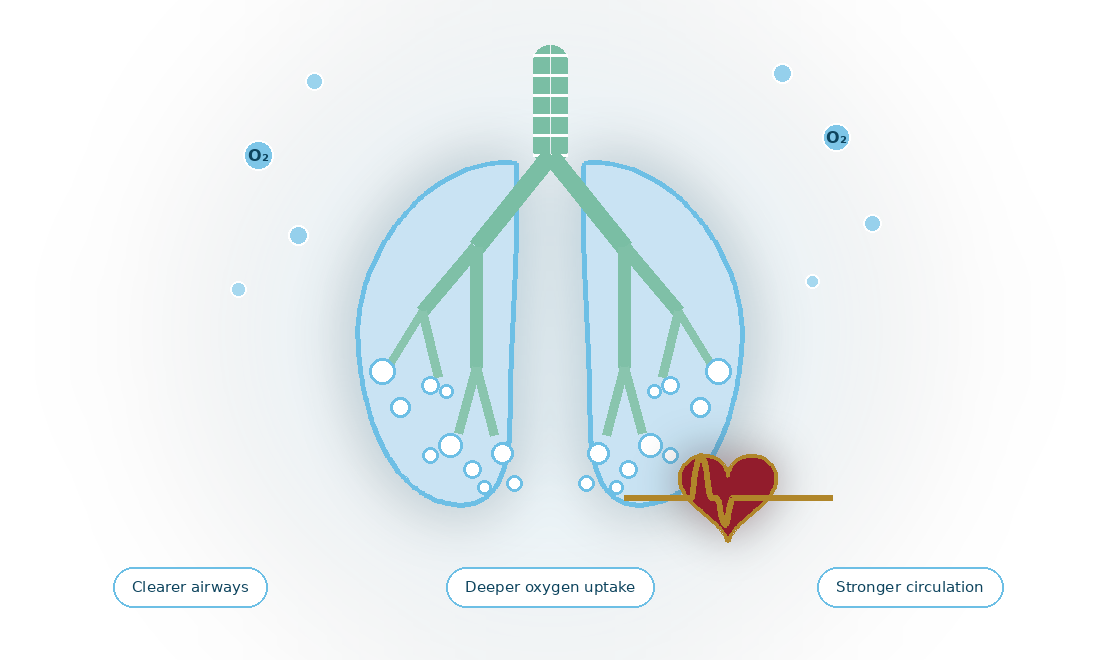
Former smokers often report the mucus-related benefits most clearly, since smoking-related mucus hypersecretion and impaired clearance frequently persist after cessation. BreathEaseX contains NAC, which reduces mucus viscosity, and glutathione precursor support relevant to the oxidative burden smoking leaves behind. It does not reverse emphysematous structural damage, which is permanent.
Where I started
Twenty-two years, roughly a pack a day, quit six years ago. The immediate benefits of quitting were real and substantial — taste returned, exercise tolerance improved over the first year, the constant chest congestion eased.
What never fully resolved was the morning cough. Fifteen to twenty minutes of clearing every day, six years after the last cigarette. My doctor had assessed it, chest imaging was unremarkable, and the conclusion was residual mucus hypersecretion that might or might not improve further with time.
That is the specific problem I was trying to address.
The first two weeks were worse
This is the part I want other ex-smokers to know about, because it nearly made me stop.
Around day five the morning coughing increased. Noticeably. More productive, more of it, lasting longer. My immediate assumption was that the product was irritating my airways.
Reading the mechanism afterward made it make sense. NAC reduces mucus viscosity, which means material that had been sitting there too thick to move becomes mobile. Improved clearance on an accumulated backlog looks exactly like getting worse.
It settled by around day twelve. Anyone who has quit smoking will recognise the pattern — it is the same thing that happens in the first weeks after cessation when cilia recover before mucus production normalises.
Address the mucus that quitting did not resolve
BreathEaseX contains NAC, the most researched mucolytic in respiratory supplementation.
What changed by week six
The morning clearing routine went from fifteen to twenty minutes down to under five. That is the single change I would have paid for on its own.
It also became less productive over time — less material, thinner, easier to move.
Exertion changed less dramatically but measurably. I walk a dog twice daily and the second half of the longer route stopped requiring a pause.
What did not change, and I did not expect it to
I have some degree of structural change from twenty-two years of smoking. That is not reversible, and I would be suspicious of any product claiming otherwise.
My maximum exertion capacity is what it is. Hills are still hills. What changed is that I am no longer operating below that ceiling because of mucus and inflammation.
That distinction matters. This did not give me back the lungs I had at thirty. It removed a layer of dysfunction sitting on top of whatever I have left.
For other ex-smokers specifically
- Expect the cough to worsen first. Around days four to twelve. It is clearance, not irritation.
- Track morning clearing time, which is the metric most likely to move for you.
- Do not expect structural reversal and be sceptical of anything claiming it.
- Keep up with medical monitoring. A changed cough in a former smoker is something to report, not to attribute to a supplement.
- Hydration matters more than I expected. The weeks I drank less, clearance was worse.
Pros and cons
What worked
- Morning clearing dropped from 15-20 minutes to under 5
- Addressed the specific residual problem of mucus hypersecretion
- Walking tolerance improved on longer routes
- Effect held steadily once established
What did not
- Cough noticeably worsened for the first ten to twelve days
- No effect on structural damage from years of smoking
- Maximum exertion capacity unchanged
- Requires ongoing use to maintain
The verdict
For a former smoker with persistent mucus hypersecretion, this addressed the specific problem more effectively than anything else I had tried. The temporary worsening in the first two weeks is worth being warned about, and it is the reason I nearly stopped. It did nothing for structural damage and I did not expect it to. If your main residual complaint after quitting is the morning routine, this is a reasonable thing to try.