BreathEaseX Review: A Recreational Runner's Assessment
Already training five days a week. The question was whether there was anything left to gain.
Tomas R.
Does BreathEaseX help athletic performance?
BreathEaseX is not formulated as a performance supplement and contains no stimulants or ergogenic aids. Its mechanisms target mucus clearance, airway inflammation and cardiovascular support, which are more relevant to people with impaired baseline function than to trained individuals. Benefit is most likely where airway inflammation or exercise-induced bronchoconstriction is limiting performance.
Why I tried it
I run about forty kilometres a week and have done for years. My interest was not performance — it was that spring and autumn reliably wreck my training for a few weeks each, and cold winter mornings produce chest tightness for the first kilometre.
So the question was narrow: does this help with the seasonal and cold-weather problems that intermittently degrade my training?
What my training data showed
I have five years of consistent training data, so I have decent baseline variance to compare against.
Pace at fixed heart rate: no detectable change across ten weeks. Within normal seasonal variation.
Resting heart rate: unchanged.
Heart rate recovery at 60 seconds: unchanged.
Perceived exertion at fixed pace: unchanged on ordinary days.
If you are looking for a performance effect, I did not find one and I would not expect anyone else to. Nothing in either formula is an ergogenic aid.
Better suited to correcting impairment than enhancing function
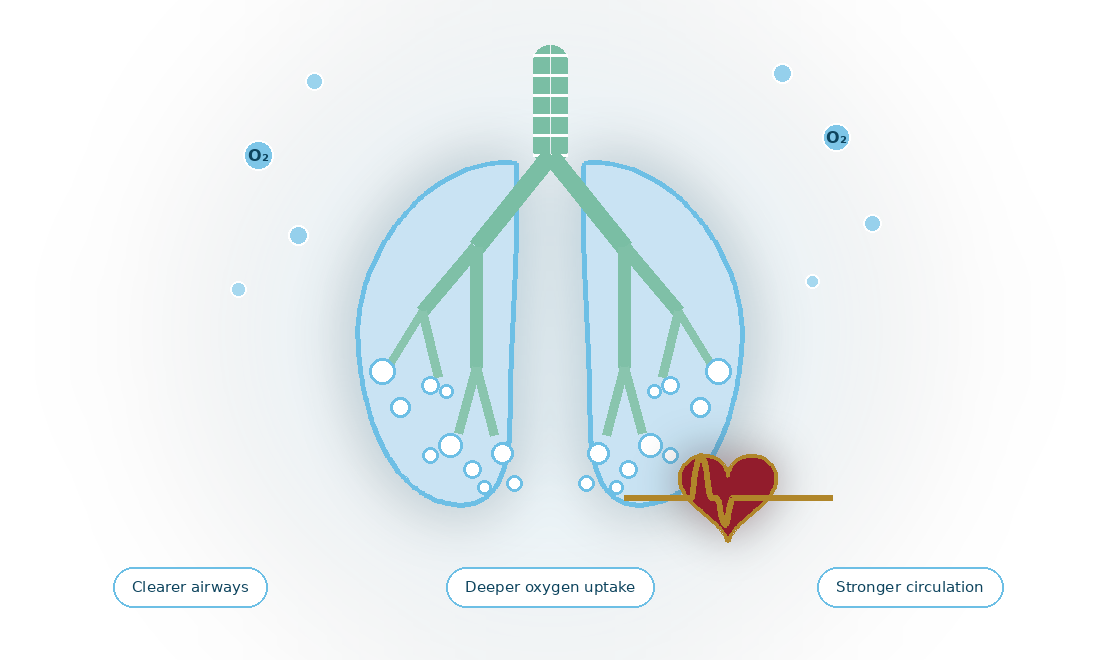
BreathEaseX targets mucus clearance and airway inflammation rather than performance.
Where I did notice something
Two specific contexts.
Cold mornings. The first-kilometre chest tightness in sub-zero conditions was less pronounced. I still had it; it was less. Whether that is the quercetin, the general anti-inflammatory arm, or a warmer autumn than usual, I cannot separate.
Tree pollen season. My worst two weeks are usually late April. This year they were noticeably less bad — I lost two sessions rather than the usual five or six. Quercetin's mast cell stabilisation is the plausible mechanism if it is real.
Both of these are contexts where airway inflammation is transiently limiting me. That fits the general pattern: the product corrects impairment rather than enhancing normal function.
The deficiency-correction point
This came up repeatedly reading the ingredient research and it explains my results.
Vitamin D benefits concentrate in people deficient at baseline. CoQ10 trial evidence sits in patients with cardiac dysfunction. NAC's respiratory evidence is strongest in populations with mucus hypersecretion.
I am a trained thirty-eight-year-old with no respiratory diagnosis, adequate vitamin D, and normal cardiac function. There is less deficit to correct, so there is less to gain. That is not a criticism of the product — it is the product working as the evidence predicts.
Someone with a genuine baseline impairment would likely get considerably more from it than I did.
What I would say to other runners
- Do not buy this for performance. It is not that kind of product and does not claim to be.
- If you have exercise-induced bronchoconstriction, get it properly assessed rather than self-treating. It is diagnosable and treatable.
- If seasonal allergy wrecks your training, intranasal corticosteroids have far better evidence and cost less. Try those first.
- The magnesium is probably the most relevant ingredient for a runner and is available separately for very little.
- Iron status matters more than anything here if you are a distance runner, particularly if female. Get it tested.
Pros and cons
What worked
- Possible reduction in cold-weather chest tightness
- Lost fewer training sessions during tree pollen season
- No stimulants, so no interference with sleep or training
- No adverse effects across ten weeks of hard training
What did not
- No measurable effect on pace, heart rate or recovery metrics
- Not formulated for performance and does not claim to be
- Trained individuals have less baseline deficit to correct
- Cheaper targeted options exist for the seasonal problems
The verdict
No measurable performance effect and I did not expect one. Some apparent benefit in the specific contexts where airway inflammation transiently limits me — cold mornings and pollen season — though my evidence there is weak and confounded. For a trained individual with no baseline impairment, the honest assessment is that there is not much deficit for this to correct, and the money would do more elsewhere.