Diaphragmatic Breathing: How to Retrain the Muscle You Stopped Using
The most important breathing muscle in your body, and most adults have quietly stopped recruiting it properly.
How do you do diaphragmatic breathing?
Lie down with one hand on your chest and one on your belly. Inhale slowly through your nose, directing the breath so the belly hand rises while the chest hand stays relatively still. Exhale slowly through pursed lips, letting the belly fall. Practise five to ten minutes twice daily. The diaphragm ventilates the lower lung where blood supply is greatest, making each breath more efficient than upper-chest breathing.
Why the pattern degrades
The diaphragm is a dome-shaped muscle beneath the lungs. When it contracts it flattens downward, creating negative pressure that draws air into the lower lung.
Several things push adults away from using it. Sustained sitting compresses the abdomen and restricts descent. Chronic stress favours rapid upper-chest breathing as part of the sympathetic response. Abdominal tension — whether from anxiety, core-bracing habits or self-consciousness about the stomach moving — actively opposes it.
The result is a learned pattern that becomes the default, and defaults are invisible until you check them.
Why it matters physiologically
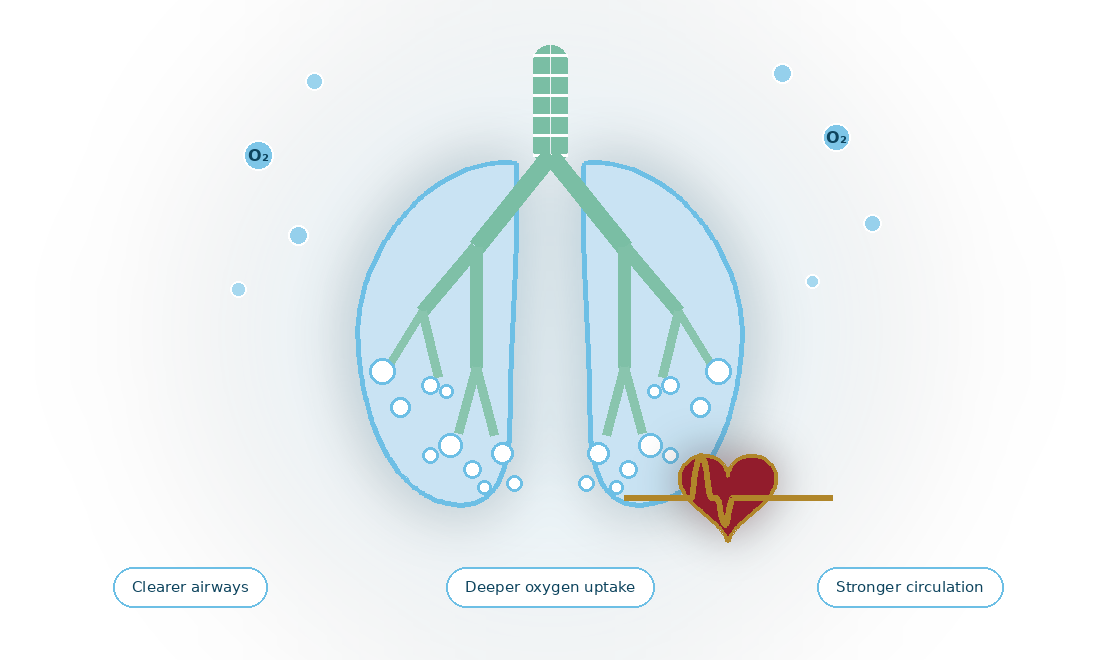
Blood flow in the lungs is not uniform. Under normal gravity the lower regions receive substantially more perfusion than the upper. Ventilating the lower lung therefore produces more gas exchange per unit of air moved.
Upper-chest breathing ventilates the region with the least blood supply. You move air, but a smaller proportion of it does useful work. Over a day of tens of thousands of breaths this inefficiency accumulates.
Diaphragmatic breathing also stimulates the vagus nerve, which is why it reliably lowers heart rate and produces the calming effect people notice within a few minutes.
The basic drill
- Lie on your back with knees bent, one hand flat on your upper chest and one on your belly just above the navel.
- Inhale slowly through your nose for a count of four, directing the air low. The belly hand should rise; the chest hand should stay relatively still.
- Pause briefly at the top, without straining.
- Exhale slowly through pursed lips for a count of six, letting the belly fall.
- Repeat for five to ten minutes. Twice daily is a reasonable starting dose.
Pair better breathing mechanics with airway support
Retraining your pattern addresses how you breathe. BreathEaseX addresses what you are breathing through.
Progressions once it feels natural
- Seated. Harder than lying down because you have to hold posture at the same time.
- Standing. Harder again.
- Walking. Coordinating the pattern with movement is where it starts becoming your default.
- Under mild exertion. The real goal — maintaining the pattern when demand rises is when it matters most.
Common mistakes
Forcing it. Straining to push the belly out is not the same as letting the diaphragm descend. If it feels effortful you are probably recruiting abdominal muscles rather than releasing them.
Breathing too fast. The point is depth, not speed. Six breaths per minute is a reasonable target during practice.
Giving up after three days. You are overwriting a pattern built over years. Two to four weeks of consistent practice before it starts appearing spontaneously is normal.
What changes
Most people notice the calming effect immediately — it is the fastest-acting benefit and the reason this technique appears in anxiety management as often as in respiratory rehabilitation.
The efficiency benefit takes longer to notice because it is subtle per breath. What people report over weeks is less breathlessness during ordinary activity and less of the air hunger sensation at rest.