Why You Cannot Seem to Take a Full Breath
Air hunger is a specific complaint with specific causes. Most of them are not what people assume.
Why can't I take a full deep breath?
The sensation of being unable to complete a breath usually reflects one of four things: shallow upper-chest breathing patterns that bypass the diaphragm, airway narrowing from inflammation or mucus, restricted rib and thoracic mobility often from posture, or anxiety-driven breathing dysregulation. Sudden onset, or breathlessness accompanied by chest pain or dizziness, requires urgent medical evaluation rather than self-assessment.
The complaint is more specific than it sounds
People describing this rarely mean they cannot breathe. They mean the breath does not feel finished — there is a sense of reaching for more air and not getting it, sometimes followed by an involuntary sigh or yawn that briefly resolves it.
Clinically this is closer to air hunger than to breathlessness, and the distinction matters because the causes differ. Someone breathless on exertion has a capacity or delivery problem. Someone who cannot complete a breath at rest usually has a pattern or mechanical problem.
Cause one: upper-chest breathing
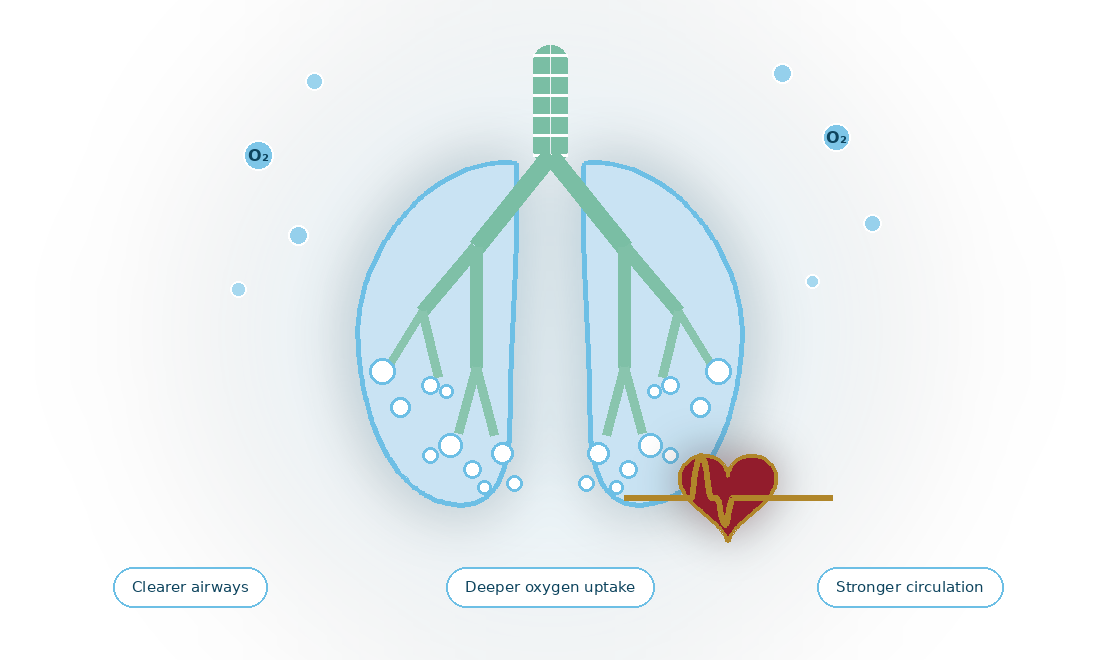
The diaphragm does the majority of the work in efficient breathing, descending to draw air into the lower lung where the greatest blood supply is. Upper-chest breathing recruits neck and shoulder muscles instead, moving the ribcage rather than the diaphragm.
This is dramatically less efficient. It ventilates the upper lung, which has less perfusion, so a given volume of air produces less gas exchange. The subjective result is exactly the described sensation: taking a breath that does not satisfy.
The test is simple. Put one hand on your chest and one on your belly and breathe normally. If the chest hand moves more than the belly hand, you are breathing into the wrong part of your lungs.
Cause two: airway narrowing
Inflammation narrows bronchi and thickens mucus, both of which increase the resistance air has to overcome. Airflow through a tube falls dramatically with small reductions in diameter — the relationship is to the fourth power, so a modest narrowing has an outsized effect.
This variety tends to be worse in the morning, worse with cold air, and often accompanied by cough or audible wheeze.
Support your airways while you address the pattern
BreathEaseX targets mucus clearance and airway inflammation while CardioEaseX supports oxygen delivery. Neither replaces medical evaluation.
Cause three: thoracic mobility
A lung can only expand as far as the ribcage containing it permits. Sustained forward posture, stiff thoracic spine segments and tight intercostal muscles all physically limit that expansion.
This is the cause most often missed, and it is worth noting that it is unusually responsive to intervention. Thoracic mobility work, rib expansion drills and simply spending less time collapsed forward at a desk change the mechanical ceiling.
Cause four: breathing dysregulation
Anxiety produces rapid shallow breathing, which lowers carbon dioxide. Low CO2 paradoxically reduces the drive to breathe deeply while increasing the subjective sense of air hunger, creating a self-sustaining loop.
The signature here is that it worsens with attention. Noticing your breathing makes it feel harder, which is not a feature of mechanical or inflammatory causes.
When to stop reading and see a doctor
Sudden onset. Breathlessness at rest that is new. Chest pain, pressure or tightness. Dizziness or fainting. Coughing blood. Lips or fingertips turning blue. Swelling in one leg alongside breathlessness. Any of these is urgent.
Persistent unexplained breathlessness over weeks also warrants evaluation rather than self-management. Anaemia, thyroid dysfunction, cardiac conditions and asthma all present this way and all are treatable once identified.