Indoor Mould and Your Airways: What Is Established and What Is Not
A genuine respiratory exposure surrounded by an unusual amount of overclaiming. Both parts are worth separating.
Can indoor mould cause breathing problems?
Yes. Indoor damp and mould exposure is associated with increased respiratory symptoms, cough, wheeze and asthma exacerbation, and is recognised in major health authority reviews. Mould spores act as allergens and irritants, and damp environments also increase dust mite populations. Claims about systemic mycotoxin illness from ordinary indoor mould are considerably less well supported.
What is well established
The association between indoor damp and respiratory symptoms is one of the better-supported findings in indoor environmental health. Major reviews, including work by the World Health Organization on damp and mould, have concluded there is sufficient evidence linking indoor dampness to respiratory symptoms, cough, wheeze and asthma exacerbation.
The mechanisms are straightforward. Mould spores and fragments are inhaled allergens capable of sensitising susceptible people. Mould also produces volatile organic compounds that act as direct airway irritants. And damp conditions independently increase dust mite populations and bacterial growth, so mould rarely arrives as the only change.
For people with existing asthma, damp housing is a recognised driver of poorer control and more exacerbations.
Where claims outrun evidence
This deserves saying because the topic attracts a lot of unsupported material.
Claims that ordinary indoor mould causes a distinct systemic illness — variously described as toxic mould syndrome or chronic mycotoxin illness, presenting with fatigue, cognitive symptoms and multi-system complaints — are not well supported by current evidence. Major medical bodies have generally not recognised such an entity, and the testing offered for it commercially has questionable validity.
This does not mean people reporting these symptoms are imagining them. It means the causal attribution to mycotoxin exposure from household mould is not established, and pursuing expensive unvalidated testing and treatment can delay identification of what is actually going on.
The respiratory effects are real. The systemic illness framework is a different claim with much weaker support.
Who is more affected
- People with asthma, in whom mould is a well-recognised trigger.
- People with allergic rhinitis or atopy generally.
- Anyone with chronic rhinosinusitis, where fungal involvement can be relevant.
- Immunocompromised people, in whom certain fungal exposures pose serious infection risk requiring specialist advice.
- People with hypersensitivity pneumonitis, an immune-mediated lung condition where mould can be the causative antigen.
- Children, who have higher exposure relative to body size.
Support airways while you fix the environment
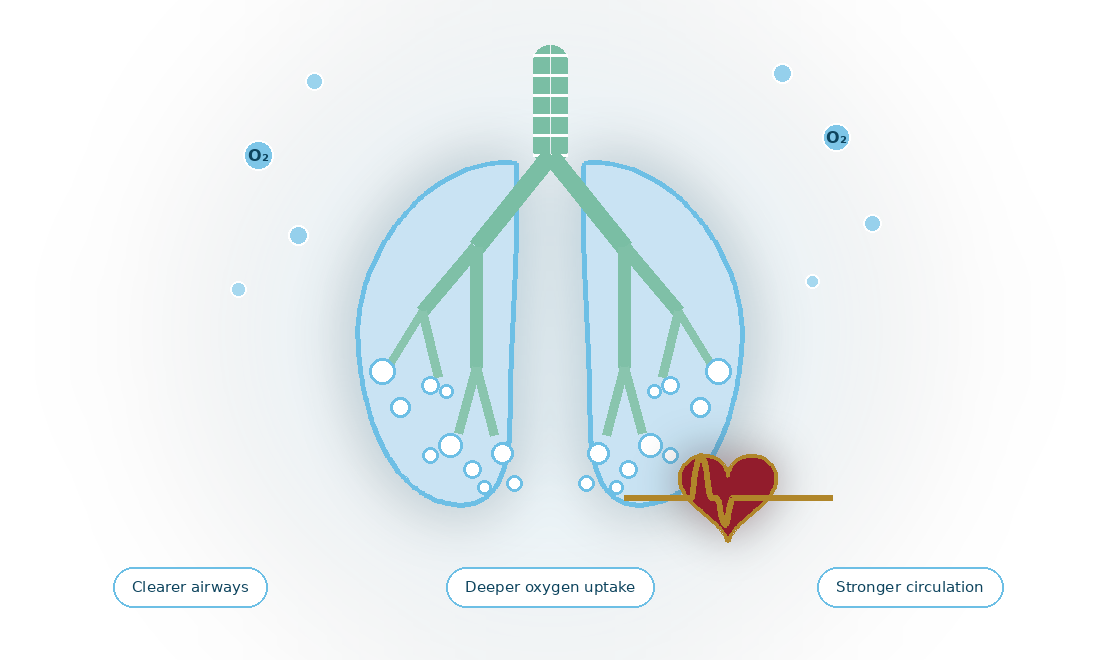
BreathEaseX includes quercetin for mast cell stabilisation and NAC for mucus clearance and antioxidant support.
Fixing it properly
The consistent mistake is treating visible mould while ignoring why it is there. Mould is a symptom of excess moisture, and cleaning it without addressing the moisture guarantees recurrence.
- Find the moisture source. Leaking pipe, roof defect, rising damp, cold bridging causing condensation, inadequate ventilation, or drying laundry indoors.
- Fix that first. Repairs, insulation, improved ventilation.
- Get humidity into the 40–50 percent range and verify with a hygrometer.
- Use extraction fans in bathroom and kitchen every single time.
- Clean small areas — under about one square metre — with detergent and water, wearing gloves and an FFP2 mask, then dry thoroughly.
- Get professional remediation for larger areas, or where mould is inside building fabric.
- Discard porous items that are heavily affected. Mould in soft furnishings, carpet underlay or plasterboard generally cannot be cleaned out.
What not to do
- Do not paint over it. It grows through.
- Do not dry brush or vacuum without HEPA — this aerosolises spores.
- Do not rely on bleach alone on porous surfaces. It removes discolouration without removing the growth beneath.
- Do not use ozone generators. Ozone is a respiratory irritant and this is a recurring bad recommendation.
- Do not buy consumer mycotoxin urine tests as a basis for medical decisions; their interpretation is not validated.
If you rent
Damp and mould from building defects are generally the landlord's responsibility in most jurisdictions, and there are often specific legal standards for housing fitness.
Document everything — dated photographs, hygrometer readings, written reports of the problem and any response. If symptoms are affecting health, a letter from your doctor documenting that carries weight.
Local environmental health departments have enforcement powers in many places and are worth contacting if a landlord does not act.