NAC for Lung Health: What the Research Actually Shows
Established chemistry, decades of clinical use, and a research record worth understanding precisely rather than approximately.
What does NAC do for the lungs?
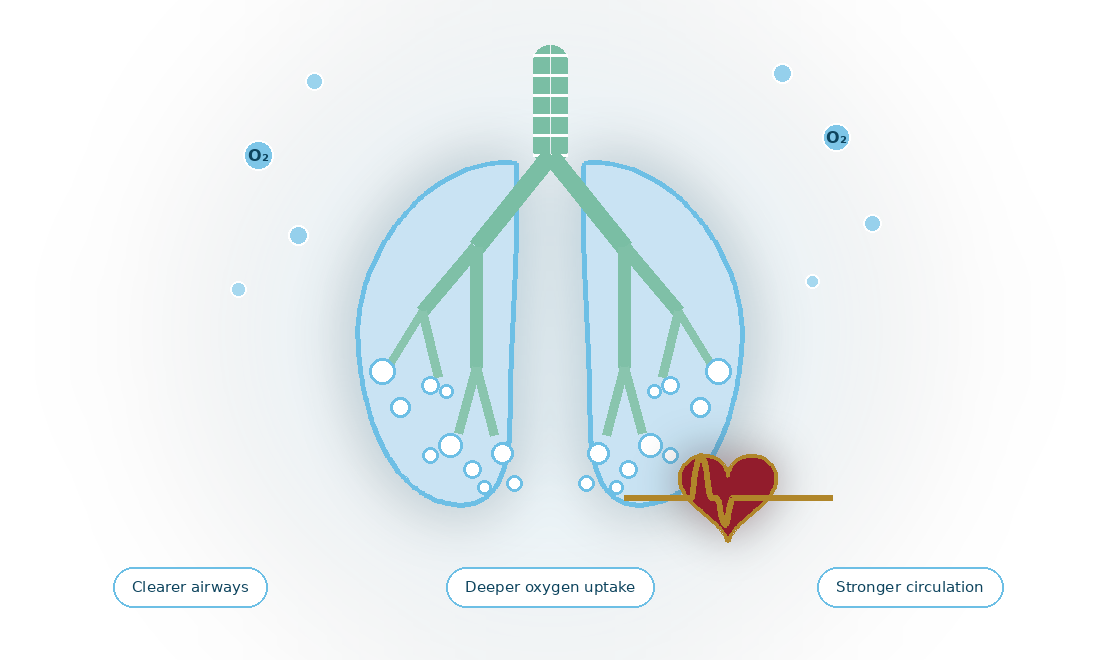
N-Acetylcysteine works on the lungs in two ways. Its free sulfhydryl group reduces the disulphide bonds cross-linking mucin glycoproteins, making mucus thinner and easier for cilia to clear. Separately, it is a direct precursor to glutathione, the lung's principal endogenous antioxidant. Meta-analysis in the European Respiratory Review has examined its influence on exacerbation frequency in chronic bronchitis and COPD.
The chemistry, precisely
N-Acetylcysteine is cysteine with an acetyl group attached, which improves stability and absorption. The functionally important part is the free sulfhydryl (–SH) group.
Airway mucus derives its viscosity largely from mucin glycoproteins linked to each other by disulphide bridges (–S–S–). NAC's sulfhydryl group reduces those bridges directly, breaking the cross-links and lowering the viscosity of the whole gel.
This is not a proposed mechanism. It is straightforward redox chemistry, demonstrable in vitro, and it is why NAC has been used clinically as a mucolytic for decades in both oral and nebulised forms.
The second job: glutathione
Glutathione is the principal intracellular antioxidant in lung tissue, and lung tissue needs it more than most organs do — it faces the highest oxygen tension in the body and therefore the highest baseline oxidative burden.
Glutathione synthesis is rate-limited by cysteine availability. NAC supplies cysteine in a form that survives to be used, which is why it raises glutathione more effectively than cysteine itself or than glutathione taken orally, most of which is broken down before absorption.
In airway disease, glutathione depletion in epithelial lining fluid has been documented, giving a coherent rationale for precursor supplementation.
What the trials examined
The respiratory literature on NAC is substantial and, importantly, mixed — which is worth stating honestly rather than citing only the favourable results.
Meta-analysis published in the European Respiratory Review examined NAC's influence on exacerbations in chronic bronchitis and COPD. Results across the broader literature have varied with dose, duration, patient population and whether participants were on inhaled corticosteroids.
The general pattern that emerges: effects are more evident at higher doses, over longer durations, in populations with established mucus hypersecretion. Trials in healthier populations or at lower doses have been less impressive.
What this means practically is that NAC's mucolytic action is reliable chemistry, while its clinical outcome benefit depends considerably on who is taking it and why.
NAC is the mucolytic core of BreathEaseX
Delivered as a spray alongside manuka honey, quercetin, olive leaf, vitamin D3 and L-theanine.
Where the evidence does not extend
NAC does not regenerate destroyed alveolar tissue. Claims about reversing structural lung damage or rebuilding air sacs go well beyond anything the literature supports.
It is also not a bronchodilator and has no role as a rescue treatment. It does not open airways acutely.
And it is not a substitute for prescribed maintenance therapy in diagnosed respiratory disease.
The interactions worth knowing
Anticoagulants and antiplatelets. NAC has antiplatelet activity and can affect bleeding time. Combined with warfarin, clopidogrel, apixaban or regular aspirin, the effect compounds. This needs a physician conversation.
Surgery. For the same reason, stopping ahead of scheduled surgery is standard advice.
Nitroglycerin. NAC can potentiate its vasodilatory effect, increasing hypotension and headache risk.
Activated charcoal reduces NAC absorption if taken concurrently.
Tolerability
NAC is generally well tolerated. The most common complaints are gastrointestinal — nausea, occasionally loose stools — usually dose-related and reduced by taking it with food.
It has a distinctive sulphurous smell, which is normal and reflects the sulfhydryl group doing exactly what it is there for.