Mucociliary Clearance: Your Lungs' Conveyor Belt Explained
Millions of coordinated cilia moving a mucus layer upward at roughly a centimetre a minute. It works until it does not.
What is mucociliary clearance?
Mucociliary clearance is the primary defence mechanism of the airways. Cilia — microscopic hair-like structures on airway epithelial cells — beat in coordinated waves at roughly 10 to 20 times per second, propelling a mucus layer upward toward the throat where it is swallowed. This continuously removes inhaled particles, pathogens and debris. Smoking, dehydration, cold dry air and infection all impair it.
The system
Your airways are lined with epithelium carrying two things: cilia, and a two-layer fluid coating.
The lower layer is thin and watery — the periciliary fluid — and it is what the cilia actually beat within. The upper layer is the sticky mucus gel that traps inhaled particles.
Cilia beat in coordinated metachronal waves, roughly ten to twenty times per second, with the effective stroke pushing the mucus layer upward. In healthy airways this moves the whole sheet toward the throat at around a centimetre per minute, where it is swallowed without you noticing.
You swallow a meaningful volume of airway mucus every day and never register it. That is the system working.
Why viscosity is the critical variable
This is the part most respiratory advice skips, and it is where NAC-type interventions act.
Cilia are powerful for their size but they are not powerful in absolute terms. They can move mucus within a fairly narrow viscosity band. Too watery and the mucus does not trap particles effectively. Too thick and the cilia cannot displace it at all — they beat against a layer that will not move.
Mucus viscosity comes largely from mucin glycoproteins cross-linked by disulphide bonds. More cross-linking, more viscosity. This is why mucolytics that reduce those bonds address a mechanical problem rather than merely a symptomatic one.
Support clearance rather than suppressing the cough
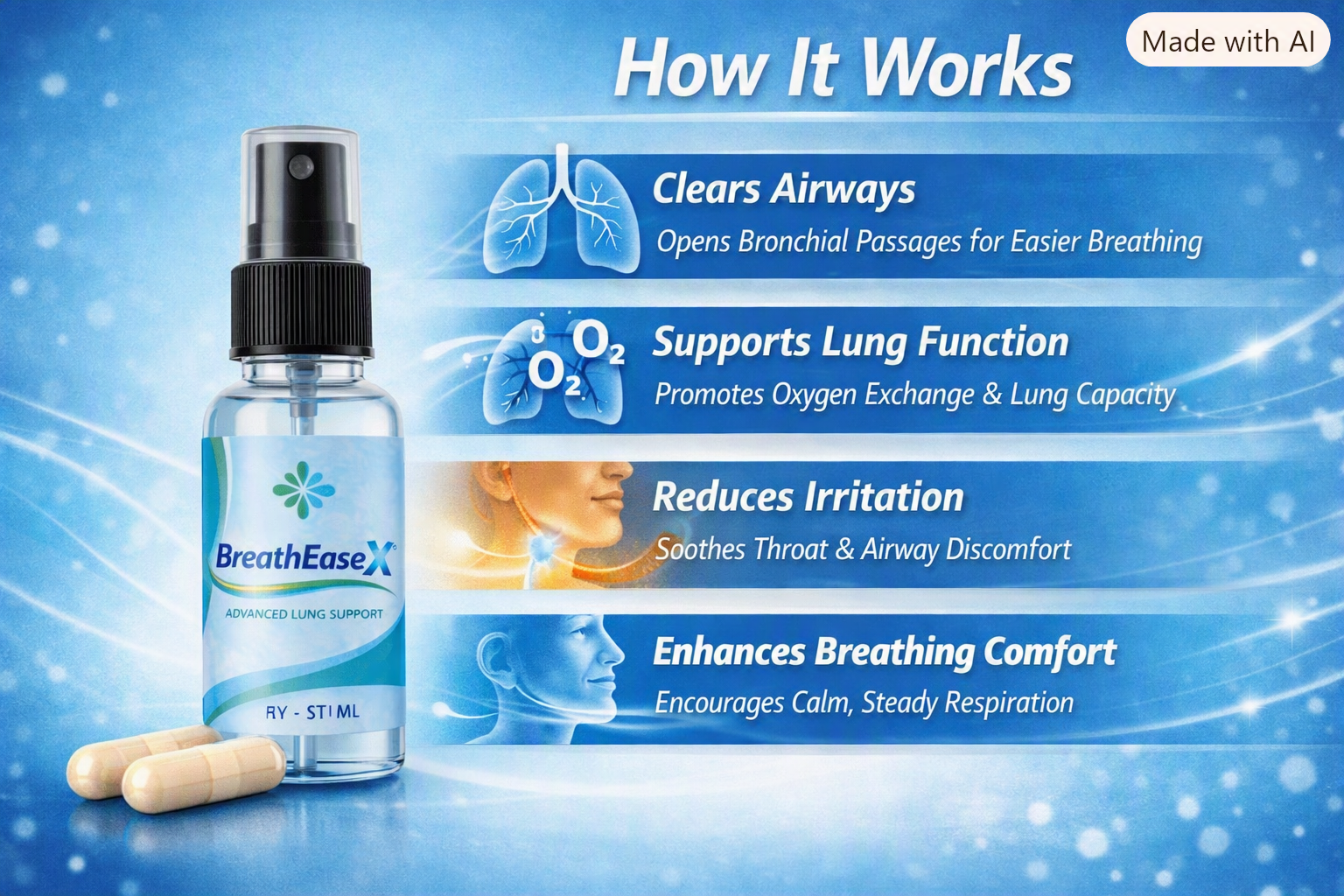
BreathEaseX contains N-Acetylcysteine, which reduces mucus viscosity back toward the range cilia can actually move.
What impairs the system
- Smoking. The most damaging single factor. It both paralyses cilia and increases mucin production.
- Dehydration. Reduces periciliary fluid depth, which the cilia need to beat within.
- Cold dry air. Thickens the mucus layer and reduces ciliary beat frequency.
- Infection. Viral infections damage ciliated epithelium directly, and recovery takes weeks.
- Air pollution. Particulate exposure increases mucus production and provokes inflammation.
- Alcohol. Impairs ciliary function at higher intakes.
- General anaesthesia and intubation. Temporarily suppress clearance, which is why post-operative chest physiotherapy exists.
What supports it
- Systemic hydration. The simplest and most reliable lever. Periciliary fluid depth depends on it.
- Humidified air, particularly overnight in dry climates or heated homes.
- Physical activity. Increased ventilation and deeper breaths assist clearance mechanically.
- Mucolytic support. Reducing viscosity brings mucus back into the range cilia can actually move.
- Nasal breathing. The nose warms and humidifies air before it reaches the lower airway. Mouth breathing bypasses that.
- Not smoking. Ciliary function recovers substantially after cessation, though it takes months.
Why it matters more with age
Ciliary beat frequency declines modestly with age, and cumulative exposure over decades leaves airways with more to clear. The system does not fail abruptly; it becomes progressively less efficient.
This is the physiological argument for supporting clearance rather than only suppressing cough. A cough suppressant on a productive cough removes the compensatory mechanism that is doing the job the cilia can no longer manage alone.