Yoga Breathing Practices: What the Research Supports
A tradition with real physiological effects, a research literature with real methodological problems, and both worth understanding.
Does yoga breathing improve lung function?
Studies of pranayama practices have reported improvements in respiratory muscle strength, some spirometry measures, breath-hold time and quality of life measures, with the strongest and most consistent findings on autonomic markers such as heart rate variability and blood pressure. Much of the literature has methodological limitations including small samples, inadequate control conditions and short duration.
The overlap with established physiology
Slow pranayama practices involve extended exhalation and breathing rates around six per minute, which is precisely the pattern with the best evidence in the mainstream slow-breathing literature.
So the core of what these practices do is not in dispute. Vagal stimulation, increased heart rate variability, baroreflex resonance and reduced sympathetic tone are the same mechanisms discussed in heart rate variability biofeedback research.
In that sense, part of the pranayama tradition is a well-developed empirical system that arrived at the physiologically effective pattern several thousand years before anyone measured why it works.
What the evidence supports reasonably well
Autonomic effects. The most consistent findings. Slow pranayama practices have been associated with increased heart rate variability, reduced resting heart rate and modest blood pressure reductions across multiple studies.
Respiratory muscle strength. Measures such as maximal inspiratory and expiratory pressure have improved in a number of studies, which makes mechanistic sense given the resisted and sustained breathing involved.
Breath-hold time and CO2 tolerance. Improve fairly reliably with practice, though this partly reflects a learned tolerance rather than a change in gas exchange.
Quality of life and symptom measures in chronic respiratory disease have improved in several trials, including in COPD and asthma populations.
Anxiety and stress measures. Consistent with the broader slow-breathing literature.
Where the evidence is weaker
This needs stating because yoga research is often reported without qualification.
Many studies are small, some with fewer than thirty participants. Control conditions are frequently inadequate — comparing a structured practice group against a no-intervention group measures the effect of doing something structured, not the specific effect of the technique. Blinding is essentially impossible, so expectancy effects are substantial.
Improvements in spirometry measures such as FEV1 have been reported but are inconsistent, and mechanistically it is not clear why breathing practice would change airflow obstruction. Findings on this specific endpoint should be treated cautiously.
Publication bias in a field with strong prior commitments is a reasonable concern.
Practice plus airway support
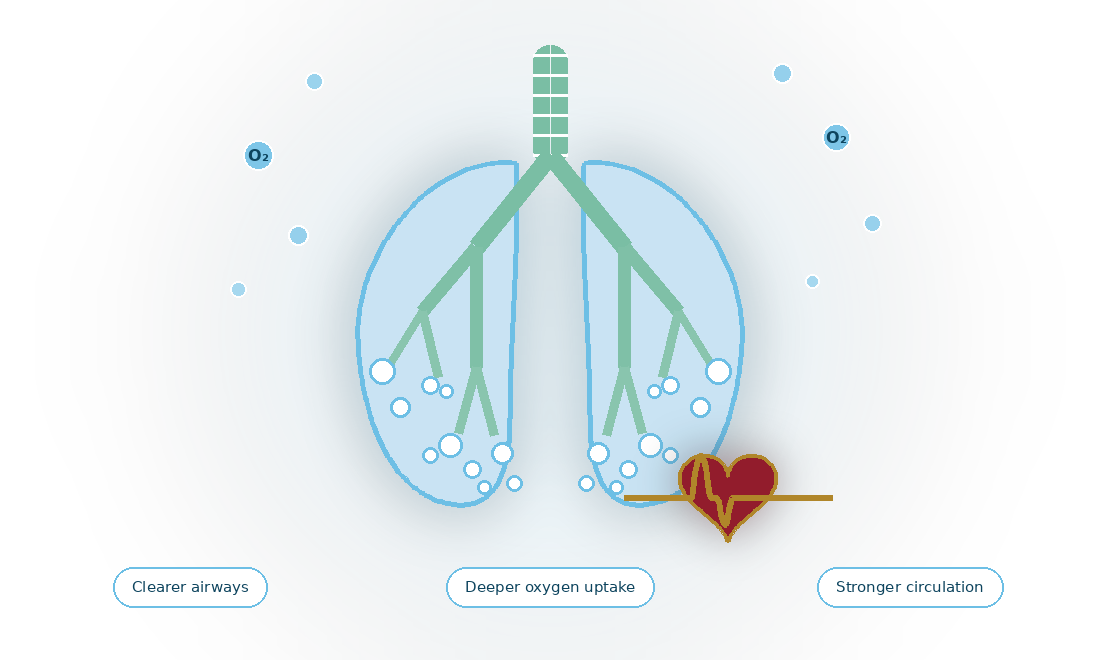
Breath practice trains how you use your lungs. BreathEaseX addresses the airway you are breathing through.
The main practices and what they do
| Practice | Pattern | Main effect |
|---|---|---|
| Nadi shodhana alternate nostril | Slow alternating nostril breathing | Autonomic balancing; among the better-studied |
| Ujjayi | Slow breathing with partial glottal constriction | Resisted breathing; extended exhale |
| Bhramari humming | Extended humming exhale | Long exhale; substantially increases nasal nitric oxide |
| Kapalabhati | Rapid forceful exhalations | Stimulating; abdominal muscle work; not for everyone |
| Bhastrika | Rapid forceful in and out | Strongly stimulating; significant cautions |
Cautions that are not always mentioned
The slow practices are appropriate for almost everyone. The rapid forceful practices are not, and this is frequently glossed over in general instruction.
- Kapalabhati and bhastrika should be avoided or approached only with experienced supervision in uncontrolled hypertension, cardiovascular disease, glaucoma or raised intraocular pressure, recent abdominal or thoracic surgery, hernia, epilepsy, and pregnancy.
- Extended breath retention is inappropriate in uncontrolled hypertension and cardiovascular disease.
- Anyone with a respiratory diagnosis should discuss vigorous practices with their doctor first.
- Dizziness or light-headedness means stop, and usually indicates over-breathing rather than skill.
A measured position
Slow pranayama practices are a well-developed delivery system for slow extended-exhale breathing, which has genuine and reasonably well-supported physiological effects.
They are worth doing if you find the framework engaging, and the group and discipline elements plausibly aid adherence more than a solitary breathing exercise would.
They are not a treatment for respiratory disease, they do not reverse airflow obstruction, and the literature supporting them is weaker than enthusiastic summaries suggest.