Incentive Spirometry: The Hospital Device With a Home Use Case
A simple plastic device with a genuine clinical purpose and a more limited home case than the marketing suggests.
What does an incentive spirometer do?
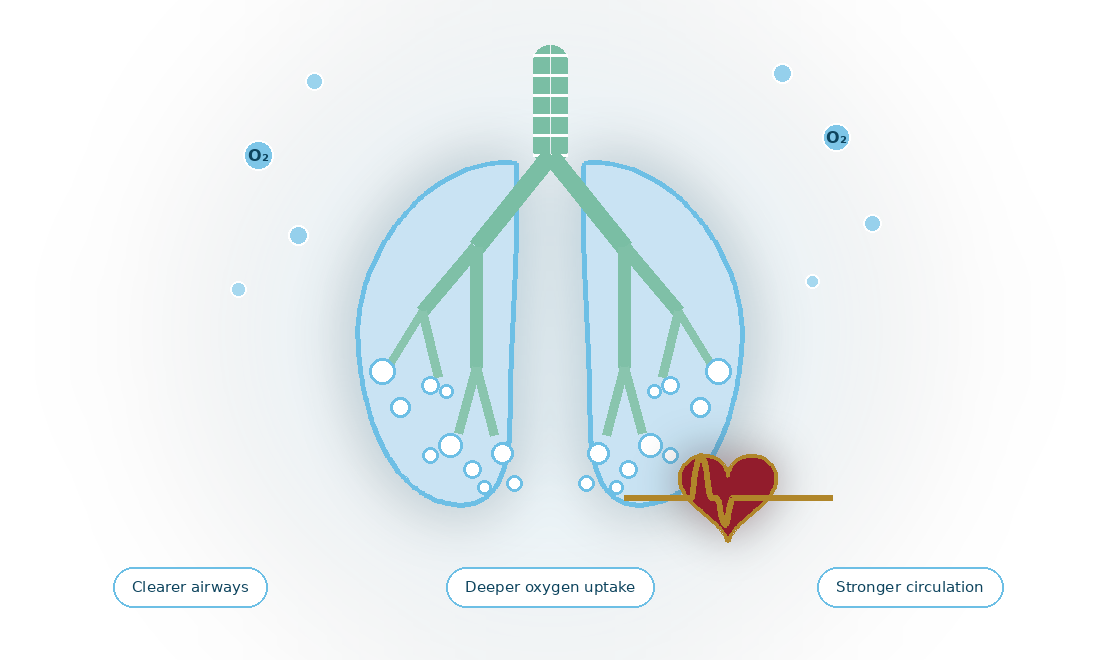
An incentive spirometer encourages slow deep inhalation held briefly at maximum, which promotes alveolar expansion and helps prevent atelectasis — the collapse of small airways and alveoli. It is used routinely after surgery, particularly abdominal and thoracic, where pain and immobility cause shallow breathing. Evidence for its use in healthy people to improve lung function is limited.
What the device does
An incentive spirometer is a plastic chamber with a mouthpiece and a piston or ball that rises as you inhale through it. A marker can be set as a target.
The design goal is specific: encourage a slow, deep, sustained inhalation. Not a fast one. The visual feedback exists to make an otherwise unmeasurable effort measurable, which improves adherence to something people otherwise do inadequately.
It measures inspiratory volume, which distinguishes it from a peak flow meter measuring how fast you can force air out. They assess different things and are not interchangeable.
Why it matters after surgery
This is the well-established use case.
After surgery, particularly abdominal or thoracic surgery, several things conspire to produce shallow breathing: pain on deep inspiration, splinting from abdominal wounds, sedation reducing ventilatory drive, and immobility.
Persistently shallow breathing leads to atelectasis — collapse of alveoli and small airways in dependent lung regions. Collapsed alveoli do not participate in gas exchange, and they also become sites where secretions accumulate and infection develops. Post-operative pneumonia is a significant complication and atelectasis is a step on the path to it.
Periodic deep sustained inhalation reopens collapsed units. The device makes that happen reliably rather than occasionally.
The technique
- Sit upright — as upright as possible. Position matters substantially.
- Exhale normally first.
- Seal your lips around the mouthpiece.
- Inhale slowly and deeply through the device, keeping any flow indicator in the recommended range rather than sucking as hard as possible.
- Hold at the top for three to five seconds. This is the part that does the work and the part most often skipped.
- Remove the mouthpiece and exhale normally.
- Rest a few breaths, then repeat — typically ten breaths per session.
- Cough afterwards to clear anything mobilised, supporting any surgical wound with a pillow or your hands.
- Repeat hourly while awake in the post-operative context.
Support clearance alongside expansion work
BreathEaseX contains NAC to reduce mucus viscosity so mobilised secretions actually clear.
The home use question, answered honestly
Incentive spirometers are widely sold for general lung health and breathing improvement. The evidence for that use is limited.
In healthy people with no atelectasis, the mechanism it addresses is not the problem. Healthy lungs already receive periodic deep breaths — sighs occur spontaneously for exactly this reason — and there is little evidence that adding device-based deep breaths improves lung function measures or exercise tolerance in people who are not post-operative or immobile.
Where a home case is more defensible: after a period of prolonged bed rest or immobility, during recovery from a chest infection where clearance is impaired, in people with limited mobility who genuinely are not taking periodic deep breaths, or where a clinician has specifically recommended it.
As a general lung-strengthening device for a healthy adult, walking uphill does considerably more.
A different device worth distinguishing
Inspiratory muscle training devices are frequently confused with incentive spirometers and are not the same thing.
These provide adjustable resistance to inhalation, training respiratory muscle strength in the way a dumbbell trains a bicep. Inspiratory muscle training has a reasonable evidence base in COPD and in some athletic contexts for improving inspiratory muscle strength and reducing breathlessness.
If strengthening respiratory muscles is your goal, that is the relevant device category. An incentive spirometer is a volume and expansion tool, not a strength training tool.
Practical notes
- Clean the mouthpiece regularly.
- Do not share the device.
- If you feel dizzy, stop and rest — that is usually over-breathing between attempts rather than the deep breaths themselves.
- Sitting upright improves achievable volumes considerably over slumping.
- Do not use it to push through significant pain without checking with your clinical team.